Presentations
Opening
Her Royal Highness Princess Laurentien of the Netherlands will officially open the Tactile Reading & Graphics Conference 2025. As a passionate advocate for literacy and inclusion, the Princess will share her vision on accessible information.
Discovering books with nimble fingers
The dzb lesen is a library and a production center for accessible media. With tactile media for early childhood literacy and events in special schools, we reach children from the very beginning and accompany them as they grow up. Reading and touching should be fun - with great books and varied ideas for promoting reading, we show how this is possible.
-
 Caroline Schürerone person(Deutsches Zentrum für barrierefreies Lesen)
Caroline Schürerone personDeutsches Zentrum für barrierefreies Lesen
Caroline Schürer studied library and information science. After holding various professional positions, including several years at the Goethe-Institut Buenos Aires, she has been working at dzb lesen since 2015.
At dzb lesen, she is responsible for reading promotion and supervises and develops exciting projects with children and young people.
How I Use Tactile Maps
Through the use of tactile maps, I will show how they help contextualize the news, to follow and comprehend current events, on a global, national and local scale. They enhance understanding of geopolitical concepts especially, illuminating locations and relations of places. Through a series of demonstrations using a tactile globe, and national, regional and local street maps, I will describe to the audience how I read map and diagrammatic materials – going from the level of North America, then California's position, to San Francisco and surrounding Bay Area counties, down to the streets of my neighborhood and the floor plan of my residence.
-
Jerry KunsMobility and Wayfinding Consultant(Mobility and Wayfinding)
Jerry KunsMobility and Wayfinding ConsultantMobility and Wayfinding
Jerry Kuns has been involved in employment development and placement of blind people since the mid 1960's, as a rehabilitation counselor and supervisor with the California Department of Rehabilitation from 1966-1975 and as an employment development specialist and project manager with sensory access foundation through 1986. He has worked with information access issues since the mid 1970's. He was employed by Humanware Inc from the late 1980's through the early 2000's and spent his remaining years as an adaptive technology specialist with the California Department of Education, retiring in 2014. He continues to work tirelessly to promote braille literacy and the use of information access tools in education and employment.
Methodical development of tactile maps of historic gardens
As part of the project "Technology for developing tactile maps of historic gardens", a comprehensive technology to developing tactile maps of historic gardens has been proposed. It covers: selection of the map content at various levels of detail, use of open data resources, design of tactile and graphic signs, principles of map generalization and editing, and reproduction using low-cost printing technology. The new approach is that people with visual impairment (PVI) have been involved in the whole process of maps design by the methodical assessment of solutions proposed at different stages of tactile mapping. There were organized 8 sessions with a group of 20 PVI each. They verified: tactile and graphic signs, editing rules, printing techniques, legibility and understanding the content of final maps. Testers were diversified in terms of sociodemographic characteristics, tactile skills and the specificity of visual impairment. The tests were based on methods and rules used in cartography (semiotics), tactile education (symmetrical difference) and IT (Technology Acceptance Model), adopted for PVI purposes. There were no relationship between tests results and characteristics of the testers. It means that the proposed solutions are legible and understandable to users due to their parameters. Our approach has been verified during development of the tactile maps of historic gardens, which support PVI to learn about gardens in Baroque, Renaissance, Romantic, English and Japanese styles. We created 13 maps and printed them using UV technic. Directly from the map, via QR code and NFC tag, PVI can connect with audiodescription with instructions on how to use the map and descriptions of the garden and its style. The maps has been given to park managements, the Polish Association of the Blind and schools educating blind and visually impaired children to serve blind recipients.
-
 Albina MoscickaAssociate Professor(Military University of Technology in Warsaw, Poland)
 Albina MoscickaAssociate ProfessorMilitary University of Technology in Warsaw, Poland
I am an Associate Professor at the Faculty of Civil Engineering and Geodesy, Military University of Technology, Warsaw, Poland. I hold an MSc in Geodesy and Cartography, a PhD and Habilitation in Technical Sciences in the discipline of Geodesy and Cartography. I have gained professional experience at Stanford University (USA), University of Stuttgart (Germany) and as a key expert in cartography in EU-funded projects in Dushanbe (Tajikistan). At MUT I teach students in cartography and GIS applications. My research interests focus on the use of geo-information technologies in the humanities, especially in the field of management, access and popularization of movable cultural heritage, as well as spatial analysis and tactile mapping. I am interested in politics, cooking and Georgian wines.
Tactile games
-
 Marc EldersMarketing Communications Associate(CBB)
 Marc EldersMarketing Communications AssociateCBB
I work since a year for the CBB. I am envolved in the marketing of our tactile Wishing Cards. I also love to promote our tactile 'Inclusive Reading books'. During the conference I am involved in the organisation and especially involved in making the conference accessible. For example we printed a tactile map of the building and a braille programbook. Get it at the infodesk! :-)
Online Tactile Maps on Public Map Portal
Public web service (tactilemaps.eu) offers the tactile maps sources in the following form:
- Automatically prepared map sheets (in A4 form) can be downloaded, printed on swell paper, and heated in fuser.
- Additional information in text form can be added to each map.
- The sources from the map portal cover any point in the world.
Come and see how it works.
-
 Petr CervenkaTactile maps maker and O&M trainer(Masaryk University)
 Petr CervenkaTactile maps maker and O&M trainerMasaryk University
Petr has been interested in tactile maps since he studied Cartography and Geography at Charles University in Prague. For 15 years he taught orientation & mmobility and trained O&M instructors. Since 2009 he has been working at Masaryk University, where he is involved in preparing tactile materials for students, preparing tactile maps and teaching spatial orientation to visually impaired students.
Learningpath 3D-2D
-
Brenda Zwijnenburgitinerant teacher(Royal Dutch Visio)
Brenda Zwijnenburgitinerant teacherRoyal Dutch Visio
Combining tactile maps with a 3D model to improve the tactile experience
Tactile Maps is a globally available service of automatically generated tactile maps for the visually impaired users. It can help create an imagination of objects and spatial information.
The aim of the new tool TACTILESET is to go even further. It connects tactile perception with additional audio description. The goal of TACTILESET is to provide the visually impaired with a comprehensive imagination of the selected place or object. The connection of the tactile map, 3D models and additional description makes it possible to significantly increase the amount of information that the user receives.
-
Barbora Bertlovástudy support worker(ELSA Support Centre for Students with Special Needs at Czech Technical University in Prague, CZE)
Barbora Bertlovástudy support workerELSA Support Centre for Students with Special Needs at Czech Technical University in Prague, CZE
My name is Barbara Bertlová and I am from the ELSA Centre of the Czech Technical University in Prague, Czech Republic.
I studied special education with a focus on visual and multiple disabilities.
At ELSA Centre I work as a study support worker for students with special needs, especially for those with visual impairments.
Tactile graphics in Swedish educational materials; production impacts on the tactile end result
In Sweden learning materials for students with blindness contain a large number of tactile graphics produced on swell paper. At SPSM we manufacture about 3,000 image originals and print about 35,000 sheets of swell paper annually. The type of images ranges from simple shapes and figures to complex illustrations used in STEM and geography. In order to facilitate reading and provide the best conditions for the students to reach their educational goals the tactile quality of these images should be as high as possible. However, the end result is affected by several variables and choices throughout the chain of production: the complexity of the original image, the amount of detail in the drawing, guidelines that govern the design, the competence of the draftsman and choice of image software as well as technical craftsmanship and choice of machinery when it comes to printing and swelling. Furthermore, properties of different brands of swell paper in combination with all of the above-mentioned variables have significant impact on the end result. For many years, we at SPSM have worked on developing our tactile graphics and improve their quality. On this occasion we would like to share examples of how different choices and conditions affect the final product.
-
 Mattias SikbergProject manager(SPSM)
 Mattias SikbergProject managerSPSM
I have a job with very varied content. I have fantastic colleagues, and several are attending this conference. I am responsible for being prepared to talk about the production of our tactile images.
Audio Tactile Graphics with Tiptoi Pen
In this workshop, we present a method of enriching tactile materials with audio information without the need for expensive specialized solutions. There have been, and continue to be, various approaches to enhancing tactile graphics for blind people with audio content. The main reason for this is that Braille takes up a lot of space, which is then no longer available for the actual tactile information of a graphic. Augmenting graphics with audio offers educational and didactic value. The toy industry such as Ravensburger company use this concept. They offer a pen that consists mainly of a code scanner, an audio playback function, and a programmable controller for reactions that are triggered when certain codes are recognized. Therefore, the pen is much more than just a code-based audio player, unlike other devices. For example, learning control elements like questions or puzzles can be integrated into specially prepared learning materials. Numerous books, such as a world atlas, farm, astronomy, and more, are available. You simply download the appropriate file onto the pen and can then work interactively with the book. In this workshop, we show how tactile material can be enriched with codes that can be recognized by these pens, which then play the recorded audio information. Programming the pen is easy to learn, and the necessary almost invisible codes can be produced with an laser printer. The graphic can then be printed with an embosser. These pens offer a low-cost solution to enrich tactile materials with audio information.
-
Gerhard JaworekComputer Scientist(ACCESS@KIT - Center for Digital Accessibility and Assistive Technology, Karlsruher Institut für Technologie)
Gerhard JaworekComputer ScientistACCESS@KIT - Center for Digital Accessibility and Assistive Technology, Karlsruher Institut für Technologie
-
Tanja Schapat
Tanja Schapat
Empowering MDVI students to Learn at Their Own Pace, in Their Own Way
We would like to show what we have developed within Visio Education Breda and what technology we use to support the education of MDVI students. These include, for example, the development of the song box; a methodology to stimulate the language and concept development of young MDVI students through songs and music and the implementation of total communication and appropriate referral systems that assist the student in clarifying the time and predictability of the day and activity. In addition, we want to show which way of working we use to also include MDVI students in the development of digital literacy and the adjustments we have made with software. The adjustment ensures that students who have a low development level can also use email programs and social media in their own way.
-
Miriam van HeesEducation Coordinator; development and Innovation(Royal Dutch Visio)
Miriam van HeesEducation Coordinator; development and InnovationRoyal Dutch Visio
Tactile urbanism
-
 Ana PetrovicAssistant Professor(Delft University of Technology)
 Ana PetrovicAssistant ProfessorDelft University of Technology
Ana is an Assistant Professor of Urban Studies at the Department of Urbanism of the Faculty of Architecture and the Built Environment, at Delft University of Technology. Her research focuses on sociospatial inequalities and she teaches geodata analysis and cartography among other things. Her aim is to enhance the quality of life in urban environments and to make (cartographic) knowledge more accessible to visually impaired people.
Ana is herself a member of 'Oog in oog', Dutch association of people with prosthetic eyes.
Closing
A closing panel with our host and all the sidekicks.
Products developed by the Visio 3D Team
At Visio, professionals have the possibility to create their own 3D printed educational materials. The Visio 3D Team supports in making and retreiving the 3D models and the production process.
During the past few years, we developed tactile materials that we think are worth sharing! for example: -Tactile ruler (VIER liniaal) -Spinning tactile dice -braille numberstick -Visio Braille Box with numerous pieces of braille models
-
 Evert RasingInnovator for VI in education(Royal Dutch Visio)
 Evert RasingInnovator for VI in educationRoyal Dutch Visio
My name is Evert Rasing, i'm an innovator at Visio in the Netherlands. I work as a project manager to improve the accessibility for blind and low vision students. A lot of these projects are related to maths and calculators, but also do a lot of work in making 3D designed tools and educational materials, using modern production technologies like 3D printing and laser cutting.
Digital learning material for braille beginners
We will show the two recent digital playful tools we have developed for blind students.
Curious fingers is a digital learning material for the youngest children who just got their braille display. It contains playful exercises that develop knowledge about the braille display and practices tactile abilities and also practise pre-braille reading techniques. It is based on an interaction between the teacher and the student.
The braille rocket is a fun alternative to printed exercis books and contains playful exercises for learning letters and numbers in braille. It is a web-application and works online in a web-browser, with full accessibility for people who navigate with screen readers.
-
Catarina HaggProject manager for Educational material(SPSM)
Catarina HaggProject manager for Educational materialSPSM
My name is Catarina Hägg. I am a project manager at SPSM where I develop new teaching materials for students with visual impairment. In recent years, I have focused on projects for developing new types of digital teaching materials for students with blindness. I have previously worked as a special education teacher with students with blindness.
I am also one of the initiators of the Tactile reading conference, that started in 2017 in Sweden.
-
 Gun OlssonProject manager(The National Agency for Special Needs Education and Schools, SPSM)
 Gun OlssonProject managerThe National Agency for Special Needs Education and Schools, SPSM
Special education teacher, now project manager at the Swedish Agency. Producing books and learning material for Braille-reading students.
It's all arrows to me
Numerous topics in the natural sciences are presented using graphics. Arrows are often used with straight, curved, or dashed shafts, showing electron movements or those of atoms, as well as those leading to an enlargement of a section in a picture-in-picture representation. Arrows represent both temporal and spatial dynamics. And sometimes, all of this can be found in a single representation. At the blista, we have developed materials and methods to convey and make real dynamics tangible. For example, chemical reaction mechanisms can be understood as a board game! Dynamics also play an important role in biology. Whether at a nerve cell axon, a chemical synapse, or in cellular metabolism: In all these vital processes, transport processes through a biomembrane play a central role. These processes can be approached with the perspective of a board game as well: a simple setup with a manageable set of rules leads to biologically correct dynamics. In this spirit: Let's play - and learn along the way!
-
Tobias MahnkeTeacher(Deutsche Blindenstudienanstalt e. V. (blista))
Tobias MahnkeTeacherDeutsche Blindenstudienanstalt e. V. (blista)
Tobias studied Chemistry in Marburg and worked in chemical research there for 4 years after his graduation. Subsequently, he switched to teacher training with the subjects Biology and Chemistry. By chance, he came to the German Blind Institute (blista) in Marburg and obtained his Master's degree in Pedagogy for the Blind and Visually Impaired while working. Later, he took over the management of the center for tactile media and models there together with his colleague Tanja Schapat. His interests focus primarily on the development of didactic concepts and materials for science education.
Co-creating Multisensory Braille Devices With Blind Children
Integrating multisensory experiences into learning instructions has shown improvements in learning outcomes. Based on the idea that multisensory experiences can scaffold learning, we co-created a multisensory device to offer engaging technologies for braille learning. This device consists of a six-button box, in which each button press elicits a specific tone, a haptic vibration or a sound and a haptic vibration. Twelve blind and thirteen visually impaired participants—including children, adolescents, and adults—along with ten sighted individuals, placed their fingers on the device to experience various braille letter patterns through auditory-haptic feedback, haptic feedback alone, or auditory cues. Participants reported enjoyment while interacting with the device, experienced a feeling of competence and felt less nervous. Most participants preferred the auditory-haptic modality, but preferences varied between groups: blind children favoured auditory-haptic and auditory modalities, while visually impaired children also liked the haptic modality. We discuss differences in sensory sensitivity and additional diagnoses, such as autism and cerebral vision impairment, as possible explanations for the varying modality preferences observed between groups. Future research will explore the adaptation of these devices for children with multiple impairments.
-
 Julia FöckerSenior Lecturer(University of Lincoln)
 Julia FöckerSenior LecturerUniversity of Lincoln
Julia is a Lecturer at the School of Psychology Sports Science and Wellbeing at the University of Lincoln. She held a postdoctoral position at the University Rochester, Brain and Cognitive Sciences, New York, USA (2010-2012), followed by a three-year-postdoctoral position at the University of Geneva, Switzerland (2012-2015) in the Department of Psychology and Educational Sciences under the supervision of Prof. Daphne Bavelier. From 2015-2018, she worked as an Assistant Professor at the Ludwig Maximilian University in Munich, Germany in the Institute of Clinical Neuropsychology. Her broad research interest is in the impact of technology use and visual deprivation on neural plastic changes in the developing and mature human brain.
Exploring the Flatbed Printer for Producing Tactile Graphics
The Swedish Agency for Accessible Media, MTM, has a government funded mission to promote tactile reading for individual needs in Sweden. To investigate whether flatbed printing could be a viable alternative to formerly established printing techniques MTM has been performing proof productions of tactile graphics using flatbed printing.
Participants will learn:
Some key findings from the proof productions
What the different proof productions feel and look like
Further plans of proof productions and aim for recommendations and guidelines
-
 Catinka GrunditzProduct Owner of Tactile Special Products(The Swedish Agency for Accessible Media, MTM)
 Catinka GrunditzProduct Owner of Tactile Special ProductsThe Swedish Agency for Accessible Media, MTM
A former Teacher of Arts and Special Education for deaf children, my work at MTM is focused on tactile products for the visually impaired. In doing this I collaborate with tactile graphic designers and other suppliers to optimize tactile graphics for different purposes, contexts and target groups.
Stories tacti’cards: Educational box of tactile cards
This box set includes 55 tactile cards representing key elements from folk tales and children’s literature: characters, animals, objects, places, and sounds. Each card features Braille and black print. Designed for blind children, the set supports story comprehension, Braille literacy, and symbolic learning, and is adaptable for inclusive and therapeutic use.
-
 Solène NégrerieTactile designer(Les Doigts Qui Rêvent)
 Solène NégrerieTactile designerLes Doigts Qui Rêvent
Solène Négrerie is Artistic Director and tactile designer at Les Doigts Qui Rêvent. She creates sensory books combining textures, Braille, and interaction for visually impaired children. She has worked on over 80 projects, including tactile adaptations, original creations, and mediation tools, often in collaboration with researchers.
Interactive tactile graphics
-
 Dan PatzeltFounder(TactileImages)
 Dan PatzeltFounderTactileImages
I am a social activist who has been fighting for 17 years to improve the quality of life of my fellow human beings.
For over 12 years, I have been fighting to increase the learning speed of the blind and deaf people globally by giving them independence in the learning process.
Haptic Tablet for the Accessibility of Digital Content to the Visually Impaired
In a world becoming increasingly digital and surface-based for all types of interactions, from shopping, communicating to using daily appliances, many people still face accessibility challenges. Currently, tactile feedback on these devices, particularly smartphones and tablets, remain limited, with content mostly visual and auditory and with simple vibrations to the whole surface.
Our work has focused on designing a novel technology, i.e. a standard tablet with localised and multitouch vibrotactile feedback capabilities, to add tangibility. It lets you feel digital graphical information through vibrations to different fingers depending on their position on the screen and the related content.
-
 Sabrina PanëelsResearch engineer(CEA List)
 Sabrina PanëelsResearch engineerCEA List
I am working as a researcher on the development of haptic interactions, i.e. interactions involving touch feedback, to convey information. This spans information about content, such as mathematical graphs, surrounding information when navigating an environment to social communication. I am particularly interested on how such technologies and feedback can support the visually impaired users.
I am currently coordinating the Horizon ABILITY project aimed at providing a haptic tablet and a novel 2D pin display, both leveraging AI capabilities, to support visually impaired users in accessing graphical digital content. I will be showcasing the progress of the tactile tablet at the Show & Tell.
Empowering vision: Bridging Craftsmanship and Language for a Brighter Future
Join me for an inspiring session where we explore how vocational training and English language learning are transforming the lives of individuals with vision impairments. In this session, you'll discover how a unique collaboration between the American Language Center of Marrakesh and the Center of Training in Craft Jobs is not only enhancing crafting skills but also unlocking new opportunities in the socio-economic market.Through immersive workshops and inclusive language lessons, participants gain independence and essential tools to create sustainable livelihoods. You’ll see how skill development and language acquisition can be a game-changer for individuals with vision impairments, offering a pathway to empowerment and a more inclusive society.
-
 Islah BoutaharCoordinator of the program for the visually impaired(American language center of Marrakesh Morocco)
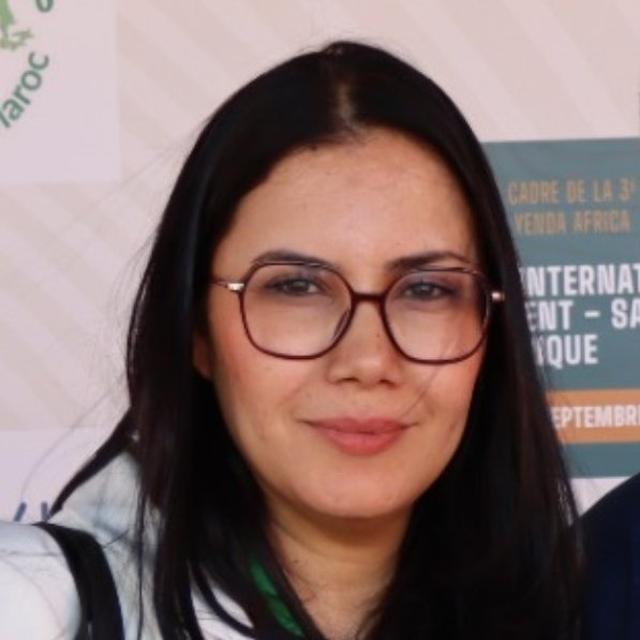 Islah BoutaharCoordinator of the program for the visually impairedAmerican language center of Marrakesh Morocco
Islah is a dedicated Coordinator with 11 years of experience supporting individuals who are blind or vision-impaired.
Specializing in English as a Foreign Language (EFL), she tailors educational materials to meet students' unique needs.
Islah fosters independence by partnering with craft centers, providing vocational training to help students gain life skills and enter the workforce with confidence.
Known for her exceptional organizational skills, she is committed to breaking barriers and creating inclusive environments for visually impaired individuals in education and beyond.
Opening: 'Science and practice in touch'
You are probably familiar with optical illusions like the famous duck/rabbit image or black and white lines that appear to spin on paper. But did you know that the sense of touch is also subject to illusions?
Prof. Astrid Kappers has been researching this for years, resulting in fascinating examples that will stay with you. But what does such haptic research mean for practical applications?
Dr. Ans Withagen, with her extensive experience working with visually impaired children and research on the sense of touch, has a wealth of examples to bridge this gap. She will focus on the concept development of people with blindness.
-
 Astrid KappersProfessor of Fundamental and Applied Haptics(Eindhoven University of Technology (TU/e))
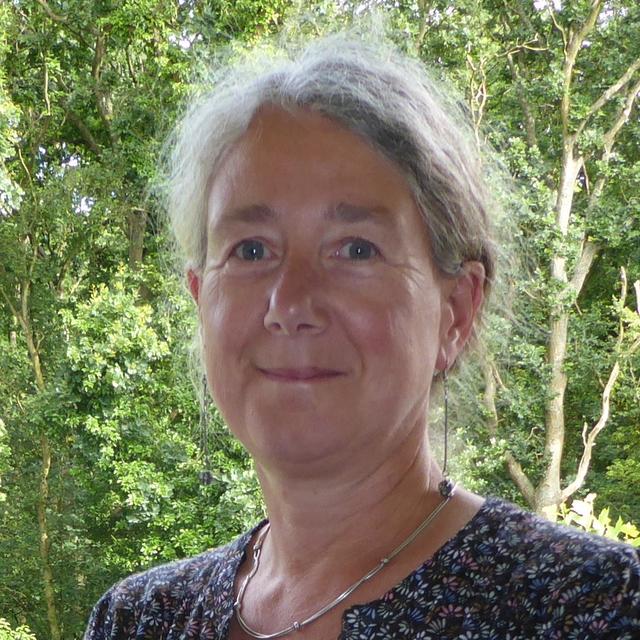 Astrid KappersProfessor of Fundamental and Applied HapticsEindhoven University of Technology (TU/e)
Astrid Kappers studied experimental physics in Utrecht. She did her PhD research in Eindhoven in the field of speech recognition using a computer. After her PhD (1989), she returned to Utrecht University, where she conducted research into visual and haptic perception. She became a professor there in 2005. After a major reorganization, she and her group left for the Vrije Universiteit in Amsterdam in 2012. Since 2018, she has been working at the Eindhoven University of Technology, where she can focus on more applied research. She has received several prestigious grants, including a VICI grant from NWO. She has served on the editorial staff of several international journals and has been frequently involved in the organization of international conferences. Under her leadership, 29 researchers have obtained their PhDs and many students have graduated. She is involved in more than 300 publications in international magazines or books.
-
 Ans WithagenSpecial Educationalist(Royal Dutch Visio)
 Ans WithagenSpecial EducationalistRoyal Dutch Visio
Ans Withagen has years of experience as a special educationalist at a school for visually impaired children at Royal Dutch Visio. Her expertise lies in the field of the tactual development of blind children. At the beginning of 2000, she and a project group started developing a Tactual Profile for children who have been blind from birth. This instrument is now used worldwide and was validated in 2005. She did a PhD study on tactual functioning of blind children.
Subsequently, she led many projects to stimulate the tactual development of blind children in education.
Inspiring and Supporting Material Kits for Children
The Swedish National Agency for Accessible Media; MTM, provides inspirational materials to children expected to become Braille readers. These materials are distributed to the families in collaboration with the Low Vision Centres throughout the country.
Participants will learn:
The purpose, concept and content of the different material kits.
How the Vow Vision Experts work with the materials together with the children and their families at Swedish Low Vision Centres
-
Catinka GrunditzProduct Owner of Tactile Special Products(The Swedish Agency for Accessible Media, MTM)
Catinka GrunditzProduct Owner of Tactile Special ProductsThe Swedish Agency for Accessible Media, MTM
A former Teacher of Arts and Special Education for deaf children, my work at MTM is focused on tactile products for the visually impaired. In doing this I collaborate with tactile graphic designers and other suppliers to optimize tactile graphics for different purposes, contexts and target groups.
-
Nicolina Pernheim Goodrich
Nicolina Pernheim Goodrich
Olymp'touch - Tactile olympic games book
-
Hoëlle Corvest-Morelcounselor and trainer(DUGTA)
Hoëlle Corvest-Morelcounselor and trainerDUGTA
Hoëlle Corvest-Morel worked for 30 years at the Cité des Sciences et de l'Industrie in Paris, making the exhibitions accessible to blind and visually impaired visitors. Blind herself, she understands the limits of museum experiences, where it is forbidden to touch anything. She pioneered the use of relief drawings and tactile/audio books to make art and science truly accessible. Today, through her DUGTA Foundation, she continues to train, advise and advocate inclusive museum experiences for people with visual impairments.
Tactile colour compass & maths aids
-
 Sylvia GoldbachDesigner and Sculptor(TAKTILES / Taktilesdesign GmbH)
 Sylvia GoldbachDesigner and SculptorTAKTILES / Taktilesdesign GmbH
What would it be like if colors could be felt? If pictures, graphics and paintings could be experienced through touch?
This question leads Sylvia Goldbach and her team 2020 to the federal school of Schleswig, Germany and the The Tactile Color Compass was developed. It translates colors into tactile surfaces.
TAKTILES is a company in Lübeck founded 2016.
With over 20 years of expertise in the field of design and industrial technologies, Sylvia Goldbach realizes coloured prints and models and graphics for inclusive media.For museums in Vienna, Berlin, Dresden, .. as well for schools for visually impaired in Germany maps, unique tangible artwork were realized are mainly 3D printed in many materials like UV ink, soft plastics, even metal and wood. We are looking forward to more cooperations!
The Gruffalo
A Children's Book Classic in a New Design
Taking our adaptation of the classic children's book „The Gruffalo“ as an example, we will show the developments in product design, especially for tactile children´s books, over the last 10 years. In 2014 in one of our first and most popular multi-material books, the Braille was still partially glued in as text areas and the book was bound in a folder. With the new edition of 2024, „The Gruffalo“ has been published in a new guise. With the combination of traditional printing, contemporary design and an interactive book concept, we inspire children and adults anew for (Braille) reading, touching and discovering.
Which aspects of the illustrations in the original book did we transfer into tactile elements? How did we create exciting and varied tactile illustrations? Which interactive features enrich the storytelling in the tactile realization?
-
 Antje MönnigTactile Graphic Designer(German Centre for Accessible Reading (dzb lesen))
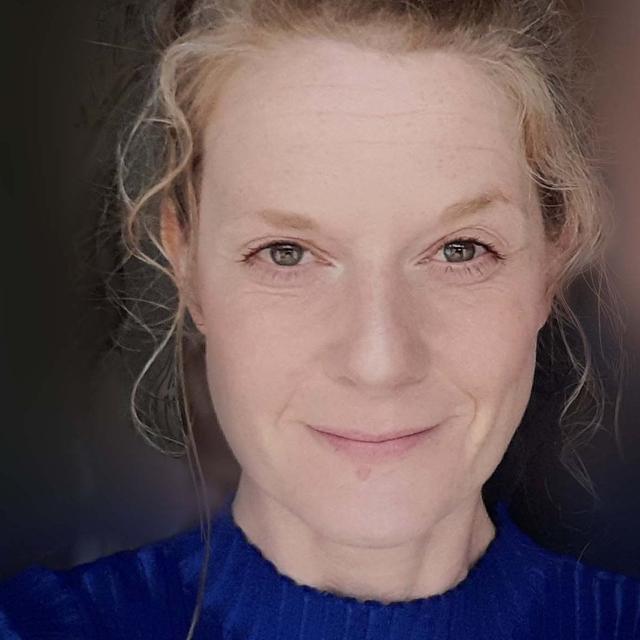 Antje MönnigTactile Graphic DesignerGerman Centre for Accessible Reading (dzb lesen)
Antje studied Communication Design at Burg Giebichenstein University of Art and Design Halle.
2014 she graduated with her master thesis „Unmöglich. Aber machbar. Inklusion für blinde und sehbehinderte Schüler“. The book was published by The German Centre for Accessible Reading (dzb lesen) and has received various awards like the Sächsischer Staatspreis für Design.
Since 2016 she has worked at the dzb lesen in the product development department. Her focus at the dzb lesen is on the conception and design of tactile children's books and she regularly trains special needs teachers and affected families in workshops for tactile books.
Antje is also co-founder of the non-profit organization einfach machbar e.V. www.einfachmachbar.de. An organisation that, among workshops, in its latest project supports families with visually impaired or blind newborns.
Liblouis: a free and open-source software library for braille transciption
Come discover the technology that you never even knew existed, but might very well power some aspect of your braille reading journey every day!
Liblouis is one of the most widely utilized software solutions for automated braille transcription. It powers braille output and input across a variety of devices, including iPhones, Android smartphones, numerous braille note-takers, and embossers. Additionally, it is integrated into screen readers such as NVDA, Orca, and JAWS. This extensive adoption can be attributed, in part, to Liblouis' versatility; it is a compact, self-contained library compatible with pretty much any hardware and software platform. This flexibility allows developers to seamlessly integrate Liblouis into their applications. Another significant factor contributing to its popularity is Liblouis' support for braille in approximately 220 languages at the time of this writing, with the ability to be easily adapted for additional languages.
In this show & tell presentation, you will learn that anyone, regardless of their background, can improve Liblouis, and that contributions, even when arising out of an individual need, can make a difference for many, as improvements quickly ripple across countless products, reaching users everywhere. We’ll also show you how the project maintains high quality through test-driven development and continuous refinement.
The presenter is one of the two maintainers of the Liblouis project, bringing valuable insights and expertise and a backpack full of inspiring stories.
-
Bert FreesSoftware Developer(DAISY Consortium)
Bert FreesSoftware DeveloperDAISY Consortium
Bert is an open-source software developer specialized in XML technologies and accessibility.
Tactile Graphics
-
M. Balakrishnan
M. Balakrishnan
Juniper and the red swoosh
-
Chi Hoon Kim
Chi Hoon Kim
Tactile books for little avid fingers
What does a castle look like? And the moon? And a jellyfish? For blind children, things that are too big, too far away or too dangerous to be touched, are not so easily understandable. While sighted children usually develop an understanding of basic concepts through incidental learning, children with a visual impairment need to learn these concepts in an intentional manner. Touching original objects or models or getting things described are different methods on how to get a better idea of the environment. At the German Federation of the Blind and Partially Sighted (DBSV) we believe that books are a great tool for young blind and partially sighted children to discover the world. As for every other child, books are for them a door to fantasy, a way of travelling to far places without moving from the chair. Unfortunately, there are too few appropiate books for visually impaired children, with quality and attractive tactile pictures. Our aim is to change this situation by creating tactile books in which children can enjoy touching different materials, awaken their curiosity, develop their fine motor and tactile skills and interact while moving the tactile elements from page to page. The books prepare blind and visually impaired children for reading in a very playful way. All the DBSV children books contain text in Braille and large print and also haptic and three-dimensional elements, many of which are interactive: doors or windows can be opened, figures moved, houses built or pears picked. Some of the books also include audio content. The books are designed in an inclusive way, also giving much importance to colors and graphic elements, so that they are attractive to both blind and sighted children. The production of the books is mostly handmade. Some elements are created with the help of technologies such as 3D printing, laser cutting, plottering or relief printing. But many others are produced by hand in order to achieve the desirable diversity of materials.
-
 Eva Cambeiro AndradeCoordinator of the DBSV Tactile Children's Books Project(Deutscher Blinden und Sehbehindertenverband (DBSV))
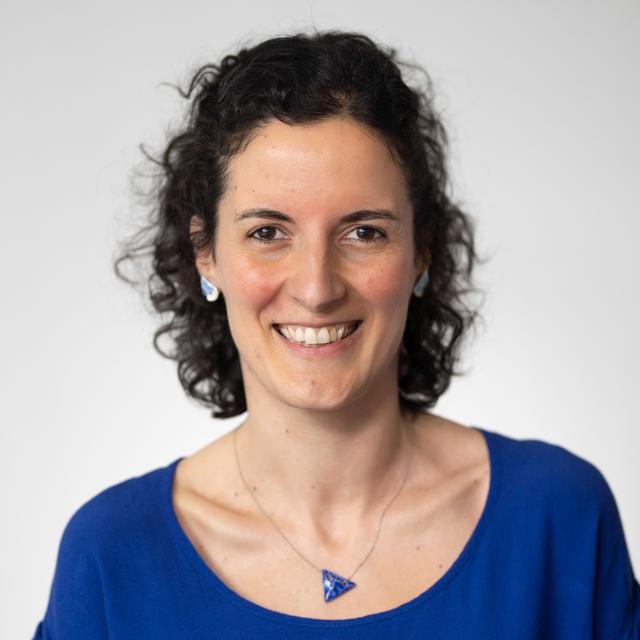 Eva Cambeiro AndradeCoordinator of the DBSV Tactile Children's Books ProjectDeutscher Blinden und Sehbehindertenverband (DBSV)
Eva was born in Spain, where she studied media accessibility for blind and deaf people. She volunteered for a year in a German school for visually impaired children and worked afterwards, back in Spain, as a coordinator for European Voluntary Service projects, hosting and sending blind and partially sighted young volunteers. Since 2012 she works at the German Federation of the Blind and Partially Sighted, in Berlin, and creates tactile children books.
Optimizing perceptual performance with pixel based tactile images
Most commercially available refreshable tactile displays are pin displays. Refreshable tactile displays could, however, be made with other techniques as well. Regardless of the technique, refreshable displays will usually be pixel based. The properties of these displays such as pixel size and pixel density will influence the perception of the graphics displayed. Visual displays have seen significant advancements in recent years, driven by new technologies. Similarly, in recent years, new innovations have been emerging for the creation of tactile displays. To make informed design decisions for such new tactile displays, it is crucial to understand how factors such as pixel size and pixel density of these tactile displays affect tactile perception. Our research systematically investigates how variations in pixel size, pixel density, and techniques such as anti-aliasing influence tactile perceptual performance. Anti-aliasing techniques are used in visual displays to smoothen the edges of pixel based images. The effects of anti-aliasing remain largely uninvestigated in tactile displays. To investigate how these factors influence perceptual performance, we make use of pixel based images that we render using swell paper and other 3D printing technologies. This allows us to systematically investigate how different aspects of tactile displays, such as pixel size and density, influence perceptual performance. The findings from our perceptual performance studies will inform the design of future refreshable displays. In this show & tell presentation, we invite people to interact with the images that we use to simulate a tactile display and explore how pixel size and density affect the tactile perception of pixel based tactile images. This way you will be able to experience the potential capabilities of future tactile display technologies.
-
Meike HeldoornPhD student(Eindhoven University of Technology)
Meike HeldoornPhD studentEindhoven University of Technology
I have always been interested in how technology can enhance human life. Because of this interest, I decided to study Human-Technology Interaction. Currently, I am a PhD candidate focusing on tactile perception. In my PhD project, I aim to contribute to creating a tactile display, with the goal to make digital interfaces more inclusive for individuals with visual impairments. By considering the haptic sense in these technologies, I hope to enhance accessibility and provide a richer, more intuitive user experience for all.
The Naked Truth: Creating 3D body models for Blind Youth
This project investigated the needs in relational and sexuality education for youth with a visual impairment (ages 12-18). The findings from literature and interviews led to the development of two lessons. One of these lessons focused on forming a concept of both the male and female body. The process of developing 3D body models will be discussed in this presentation.
-
 Dilana SchaafsmaAssociate lector(Fontys University of Applied Sciences)
 Dilana SchaafsmaAssociate lectorFontys University of Applied Sciences
Dilana Schaafsma works as an associate lector at Fontys University of Applied Sciences. There, she leads her own research line titled "Healthy Sexual Development". The mission of this research line is "to promote the sexual health of children, adolescents, and young adults, and to prevent unwanted experiences." Within this framework, there is specific attention for youth with disabilities.
In addition, she is Clinical Director of Happy Hearts, a program within the Special Olympics, where she and fellow volunteers provide education on relationships and sexuality to athletes with intellectual disabilities.
Image-to-audio comics
With all the technologies that we have at our disposal nowadays, we can say that there is no comic book that is non-accessible on one side and accessible on the other. There is a progressive accessibility that needs to be implemented. Why? Because it's difficult. What needs to be done for the visually impaired, the blind, those with dyslexia, and those with motor disabilities are not the same adaptations. Moreover, there is an industrial issue that complements the artisanal issue of adaptive organizations. Therefore, there are scaling problems. Since we started our partnership on accessible comics with ComixSuite and La Rochelle University, we always thought that we needed to work step by step, from small, easy comics to complex ones, that’s why we tried to work on different sides. Therefore, we are focusing our effort on a set of tests with multiple comic book audio description with human narratives scripts compared to automatic audio description to bring comics to people with disabilities.
-
 Basile MignonneauHead of the production departement(Association Valentin Haüy)
 Basile MignonneauHead of the production departementAssociation Valentin Haüy
After 9 years in publishing and digital publishing, I joined the Valentin Haüy Association in 2020 to put my skills and knowledge to the benefit of people with sight disabilities.
I'm now working to improve the numbers of adapted books in France through semi-automatic solutions to bring more adapted books (Full Daisy and Digital braille) to our users (17k people).
-
 Christophe RigaudAI Research Scientist(La Rochelle University)
 Christophe RigaudAI Research ScientistLa Rochelle University
Christophe Rigaud (Ph.D.) is a researcher in document image analysis at the L3i laboratory and AI architect at Comix Suite company in La Rochelle, France. He received a double European PhD degree in computer science from the University of La Rochelle (France) and the Autonomous University of Barcelona (Spain) in 2014.
His research focuses on the analysis of comic book images by combining computer vision techniques and recent large language model capacities. He aims to find and develop methods to automatically describe comic book content for diverse application such as content retrieval, interactivity, translation, accessibility, audio description etc.
The Basic set and it’s toolbox of the learning path Draw Along for blind children aged 4-12
Drawing strengthens concept development and self-expression. However, many blind students are not given the opportunity to experience drawing, often because their teachers may not know how to incorporate drawing or what tools to use. Which basic skills are necessary to start drawing? This was the question we asked ourselves when we started the project ‘Draw Along’ with the assignment to develop a learning path for blind children to teach technical and creative drawing skills systematically. We discovered that each image can be reduced to seven lines and three shapes. These lines are taught in the Basic set of Draw Along through tactile experience, allowing the student with severe visual impairment to display their tactile impressions on drawing foil. Using these lines on drawing foil, students have a language to draw objects experienced through touch. The basic set of lines and shapes also provides the opportunity to engage in an equal conversation about how the blind student experiences the world through touch and how it is visually represented on paper. Multiple lessons practice drawing skills in a multimodal way. For example with the use of different materials and tools, movements, stories and music. VI schools and itinerant teachers now have access to boxes containing lessons and materials to teach drawing systematically. We will show you the lines and shapes, the multimodal way of teaching, and guidance tips for the teacher. Also the developed material will be demonstrated. Experience the unique way of communicating and expressing through tactile drawings!
-
 Alies Aarts -van der MoerOccupational Therapist(Royal Dutch Visio)
 Alies Aarts -van der MoerOccupational TherapistRoyal Dutch Visio
Alies graduated as an occupational therapist in 2000 and started working at Visio in the same year. Now she has 25 years of experience, working with young visual impaired children. She is a teacher of the 'Tactual Profile' and 'The Young Blind Child' courses.
She is also a trainer for International Programs, where she met Ans Withagen who asked her to join the project Draw Along because of her experience with young blind children.
-
Noortje OpsteeghArts and Craft teacher(Royal Dutch Visio)
Noortje OpsteeghArts and Craft teacherRoyal Dutch Visio
Closing
Museums often present valuable artefacts and artworks behind barriers, making them inaccessible to people who are blind or have low vision (BLV). This limits meaningful engagement with cultural treasures that shape our understanding of history and the world. Human perception goes beyond sight—it includes touch, sound, smell, and taste.
In this keynote, Cathelijne Denekamp (Manager of Accessibility & Inclusion, Rijksmuseum) and A/Prof. Dagmar Reinhardt (The University of Sydney) discuss strategies for creating more accessible and inclusive museums.
Cathelijne works on improving physical, social, and digital accessibility at the Rijksmuseum, aiming to create an environment where everyone feels welcome. She is also the author of "Accessibility Without Limits - Rijksmuseum", a book documenting the museum’s journey toward greater accessibility.
Dagmar leads the “Museum of Touch” project, which focuses on tactile models of museum objects for BLV audiences. These 3D-printed models make objects, often too fragile or valuable to touch, accessible to all visitors.
Together, they explore cutting-edge design strategies and technologies—such as the WESSST principles for touch design, photogrammetry, and 3D printing—that are reshaping the future of inclusive museum experiences. Key questions include: How can we achieve lasting change? How can we encourage deeper participation? How can touch-based engagement transform the museum experience for all?
-
 Cathelijne DenekampManager accessibility(Rijksmuseum)
 Cathelijne DenekampManager accessibilityRijksmuseum
The Rijksmuseum is the largest museum in the Netherlands dedicated to art and history. The forefront of making this institution truly accessible is Cathelijne, who is committed to ensuring that all visitors and employees experience the museum on equal footing, feeling welcome and recognized.
Cathelijne's work spans across physical, social, and digital accessibility, focusing on creating an environment where everyone can participate and feel a sense of belonging. Her efforts include making the museum a more accessible employer and ensuring diverse representation within the collection. This holistic approach aims to build a solid foundation for the Rijksmuseum to be a museum for everyone.
Her philosophy is simple yet profound: an accessible museum is a better museum for all. To share the Rijksmuseum’s journey towards accessibility, Cathelijne authored a book, "Accessibility Without Limits - Rijksmuseum," Accessibility without limits - Rijksmuseum. which chronicles the strides taken and the lessons learned in this ongoing mission.
-
 Dagmar ReinhardtA/Professor of Architecture(The University of Sydney)
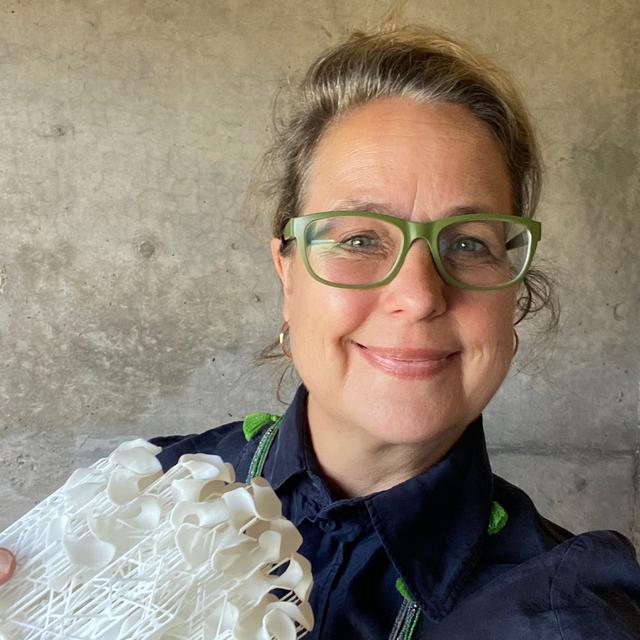 Dagmar ReinhardtA/Professor of ArchitectureThe University of Sydney
Dagmar invents, designs, makes, thinks, discusses and creates with and for people of all ages. She is an associate professor, researcher and design studio teacher at the School of Architecture,, The University of Sydney and a practising architect (reinhardtjung).
Dagmar's research focuses on human-centric and sense-based design linking architecture, acoustics, robotics and accessibility. She is at the moment working with blind and partially sighted children and their parents and carers to improve museum curations and exhibition, and she and her team explore how playgrounds can become better places for all citizens - young and old.
Exploring multisensory (tactile-auditory) pictures
How do people who rely on haptic touch explore multisensory (tactile-auditory) pictures? And what sensory information do they prefer? A museum-based study will be presented in which qualitative interview and observation data were collected from a focus group (N 8) over 16 sessions. All participants started relying on haptic touch after the age of 18 and had done so for more than 10 years before this study. Their visual acuity ranged from total blindness to minimal visual shape perception. The study found that the visitors either explored the tactile picture or listened to the audio-description first; never the two simultaneously. All visitors preferred the audio-description to start describing where their fingers were and to activate, pause, and stop it themselves. On the tactile picture, everybody explored the global (shape) outline of each element and, when struggling to identify the element, activated the audio-description. They preferred two layers of audio-description: the first identifying the element and the second reading the curator’s information. Regarding the global elements in the tactile pictures. They preferred that the global (shape) outline was clearly defined - easy to feel from both the inside and the outside without interruptions (e.g., from textures) - and straightened out so that curves become angular. Although tactile texture attracted their attention, they preferred that it was used only on specific elements (e.g., those mentioned in the curator’s information). Finally, they preferred that tactile pictures be printed on swell paper: line width 1.2 mm and height 0.6 mm, and audio-descriptions read by a female alto voice. We suggest that certain exploring strategies and preferences are universal to haptic touch and universal to hearing regardless of personal experience and, thus, that the development of new tactile and/or auditory pictures should be based on these.
-
Torø GravenResearcher(University of Oxford)
Torø GravenResearcherUniversity of Oxford
Anchored in Psychology and Special Needs Education, my research focuses on understanding how people who rely on active (haptic) touch perceive and process information, and how this is affected by vision and hearing. Using this knowledge to develop new teaching methods and teaching materials in schools and universities, re/habilitation programmes, and informal education, I aim to empower haptic touch, hearing, or both in supporting or replacing an impaired vision, for example, in memory retrieval and shape recognition.
I use both quantitative and qualitative research methods – combining speed, accuracy, drawing, and/or think-aloud data – and have developed research methodology for identifying problem-solving strategies (qual-quan) and the effect of previous sensory experience and learning (quantitative). I have also started tracking the exploring movements and exploring pressures of haptic touch (quantitative research method) using a prototype TouchTracker.
Blog: SmartSense – https://blogs.ed.ac.uk/smartsense/
Podcast: The Oxford Sound Album – https://podcasts.ox.ac.uk/series/oxford-sound-album and blog post https://www.torch.ox.ac.uk/article/the-oxford-sound-album-how-it-started
Publications:https://orcid.org/0000-0002-4524-3431and https://www.cristin.no/
!!! New paper: Hearing the city without vision: An exploratory study https://doi.org/10.1177/02646196251330184
Tactile storytelling and the purpose of play
Join us for an interactive workshop exploring the power of tactile storytelling through the creation of accessible illustrations. We will guide participants in using reclaimed materials to design and construct tactile artworks that can be enjoyed by both visually impaired and sighted individuals with the creative process led by the participants’ sense of touch. This hands-on experience will foster creativity, problem-solving, and a deeper understanding of the importance of inclusive storytelling. Key Outcomes: Participants will gain practical skills in creating tactile illustrations using recycled materials. Attendees will develop a greater appreciation for the role of tactile experiences in storytelling. The workshop will promote a sense of community and shared creativity among participants. Materials: A variety of recycled materials, such as cardboard, fabric scraps, buttons, and natural elements and necessary tools will be provided. The authors each contribute a unique skill set to the workshop: Stephanie Simpson is an educator and illustrator with a background in mixed-media crafting and visual storytelling and Wilna Combrinck is an educator and graphic designer with experience in multimodal tactile design for children.
-
 Wilna CombrinckGraphic Designer/Lecturer(South African Library for the Blind/Red & Yellow Creative School of Business)
 Wilna CombrinckGraphic Designer/LecturerSouth African Library for the Blind/Red & Yellow Creative School of Business
Wilna Combrinck is a graphic designer with a focus on food, lifestyle, and non-fiction publications. In addition to her professional work, she shares her expertise as a part-time lecturer at Red & Yellow Creative School of Business in Cape Town, South Africa. Wilna also contributes her design skills to the South African Library for the Blind, where she is a tactile picture book design volunteer. Her areas of special interest include children’s literacy, literacy acquisition in low-income communities, and design accessibility for people with visual impairments. Her Master of Art dissertation examined tactile design for visually impaired children within South Africa’s multilingual context.
-
 Stephanie SimpsonIllustrator/Illustration lecturer(Red & Yellow Creative School of Business)
 Stephanie SimpsonIllustrator/Illustration lecturerRed & Yellow Creative School of Business
Steph Simpson is an illustrator practicing under the name "Me and Norman".
She navigates the creative process through the eyes of her imaginary friend, Norman, who is responsible for the chaos and silliness in her work. With Norman's help, Steph feels fearless and is able to stare a blank page straight in the eye and conquer it. She is very focused on the process and place that she climbs into when illustrating – a world that she is unable to leave once the image starts to take form.
She also lectures illustration at Red & Yellow, Creative School of Business in Cape Town, South Africa. She encourages her students to experiment and “play until something happens”, to reach a creative solution.
Above all, she sees herself as a storyteller, extending to all spheres of her life - whether she is at her desk, in her home studio or in the classroom with her students. For her, "Illustration is visual storytelling and making images is a kind of game I play to amuse myself."
She completed a Masters in Visual Arts (UNISA 2024) along the topic of creativity and the significance of play and the imagination in spurring on creativity.
Magic of touch: Tactile graphics and exercises for preschool children with visual impairment
-
 Susanna RuohonenLearning Material Designer(Accessibility Library Celia)
 Susanna RuohonenLearning Material DesignerAccessibility Library Celia
I have many years of experience as a learning material designer at the Accessibility Library Celia in Finland.
Different versions of the Tactual Profile for different target groups
Some of the professionals will know the Tactual Profile from Royal Visio. An observation instrument for regular blind children and students in the age of 0-16 years. In addition to this there is a short version of the Tactual Profile which is easier to observe with students. In 2017 Royal Visio developed The Tactual Profile-MDVI for Multiple Disabled and Visually Impaired Children in the developmental age 0-6. After more then 7 years this instrument has shown to be worthful for this target group, and for children with multiple disabilities and severe CVI. A last version is recently developed and almost finished. This is the Tactual Profile-DB for adults with acquired deafblindness. When you are losing your hearing and vision over the years, the tactile sense becomes more and more an important compensatory sense. The TP-DB can help in awareness about the sense of touch and in giving direction for further interventions. We will show you the different versions and explain the differences between them.
-
Alies Aarts -van der MoerOccupational Therapist(Royal Dutch Visio)
Alies Aarts -van der MoerOccupational TherapistRoyal Dutch Visio
Alies graduated as an occupational therapist in 2000 and started working at Visio in the same year. Now she has 25 years of experience, working with young visual impaired children. She is a teacher of the 'Tactual Profile' and 'The Young Blind Child' courses.
She is also a trainer for International Programs, where she met Ans Withagen who asked her to join the project Draw Along because of her experience with young blind children.
-
Chantal te BoekhorstBraille teacher and tactile trainer, itinerant teacher(Royal Dutch Visio)
Chantal te BoekhorstBraille teacher and tactile trainer, itinerant teacherRoyal Dutch Visio
-
 Miranda ZwijgersOccupational Therapist(Royal Dutch Visio)
 Miranda ZwijgersOccupational TherapistRoyal Dutch Visio
I am an occupational therapist since 2001 and working for the Royal Dutch Visio since 2010. Started in Amsterdam I am know working for the Rehabilitation & Advice location in Rotterdam. I see as well children from 0-18 as people with visual and intellectual disabilities from 0 - 99+.
Recently I finished a master in Occupational Science and my Master's Thesis was focused on the occupational transitions for adults with the Usher syndrome type 2.
Over the years at Visio my expertise developed towards the topics sensory processing in relation to CVI and the use of touch, especially with children who are experiencing severe sightloss.
Tactile Theme Packages as a Braille Reading Motivator
-
 Marjo KauttonenCoordinator(Accessibility Library Celia)
 Marjo KauttonenCoordinatorAccessibility Library Celia
I have been working at the Accessibility Library Celia In Finland since 2007. In Celia I am in charge of the book collection for children and young people, and also Celia’s braille book collection for adults. I am also a member of Finnish Braille Authority.
I am interested about how to get children to read, and especially how to get them read in braille.
I lead a working group that designs books that combine both braille and tactile images for children who are just learning to read. The working group came up with the idea to combine tactile images and braille books on a specific theme. We hope that these themed packages will encourage children to borrow and read more braille books.
Keynoa - Synesthesia or Seeing More With the Fingers
Synesthesia is a human brain ability in which information meant to stimulate one sense stimulates other senses. Research suggests that about 5% of world population are synesthetes. For example syntesthetes are able to hear colours and others can visualise sounds. This demonstrates that the human brain is perfectly capable of substituting, to some extent, vision with other sensations like vibrations on the fingers.
Keynoa capitalizes on this natural human ability by introducing its novel concept of “Seeing More With the Fingers." For instance, Keynoa allows blind people to read text characters, explore graphic images, sense colors, feel objects and evaluate their distance before touching them simply by receiving gentle vibrations on the fingers.
-
 Ibrahim CherradiCEO(Keynoa)
 Ibrahim CherradiCEOKeynoa
In 1976 at the age of 18, I left my country of birth Morocco, to my country of university studies France. Ten years later I was hired at the International Atomic Energy Agency in Vienna in my country Austria.
With a Doctorat d'Université en Energétique and a Diplôme d'Ingénieur en Génie Atomique form Université de PARIS, INSTN Saclay, CNRS, France, and over three decades in the field of nuclear instrumentation provision at the IAEA, my expertise lies in developing and implementing non-off-the-shelf solutions for IAEA safeguards nuclear inspections, including R&D of instruments and software. With my proficiency in cradle-to-grave equipment development and multiple data acquisition and analysis and ICT expertise, I demonstrated my ability of directing large teams of engineers and technicians designing and executing complex and customised hardware and software systems.
As the founder and CEO of Keynoa Technologies - a company developing specific innovative assistive technology solutions for visually impaired and blind persons - I lead the development and implementation of the company's strategy, vision, and mission.
I obtained a number of EPO and USPTO patents for the Keynoa method.
Math ratio teaching material that can be operated by touch
Focusing on the study of “ratio,” this study development of math ratio teaching materials that can be operated by touch and conducted a questionnaire survey of teachers experienced in teaching the visually impaired to clarify the usefulness of the material.
-
 Momoko MashioMaster's Student(University of Tsukuba, Japan)
 Momoko MashioMaster's StudentUniversity of Tsukuba, Japan
Ms. Momoko MASHIO is a master’s student at Graduate School of Comprehensive Human Sciences, University of Tsukuba, Japan. Hers major is special needs education and she is researching on math teaching material for children with visual impairment.
-
 Moe NakajimaMaster's Student(University of Tsukuba, Japan)
 Moe NakajimaMaster's StudentUniversity of Tsukuba, Japan
Ms. Moe NAKAJIMA is a master’s student at Graduate School of Comprehensive Human Sciences, University of Tsukuba, Japan. Hers major is special needs education and she is researching on Social studies for blind children, especially map learning.
-
 Sota SebataGraduate student(Graduate School of Comprehensive Human Sciences, University of Tsukuba)
 Sota SebataGraduate studentGraduate School of Comprehensive Human Sciences, University of Tsukuba
Mr. Sota SEBATA is a master's student at Graduate School of Comprehensive Human Sciences, University of Tsukuba, Japan. His major is special needs education and he is researching on tactile symbols for children with multiple disabilities.
Two Traditional Board Games of India Enjoyed by Vision Impaired People
Indoor games when played with friends or family members promote social interaction, develop emotional intelligence and cognitive skills apart from relieving stress. There are many tactile board games designed, adapted for visually impaired people and are commercially available in the market. However, some games are practiced, played but confined within certain geographical regions or countries. In this article two of the popular board games of India viz., Dhaayam, and Pallaanguzhi are discussed. Dhaayam has a few variants but the underlying principle remains the same. Generally, two or more players are involved as individuals or as teams. The basic game board is arranged with 49 square cells as a 7 X 7 grid. The game is played by moving the coins along the cells depending upon the outcome of dice value. Players are allowed to start the game only on getting the count 1 on the dice. A player needs to slash at least coin of the opponent before moving all his/her coins to destination cell. Some cells are earmarked as safe zones where the coins cannot be slashed. This game generates lot of excitement and demands thinking to make safe moves, and to secure home cell at the earliest. Pallaanguzhi is a two-player game, the game board is carved with fourteen cup-like pits, each player owning seven pits on his/her side. Initially each pit is filled with five cowry shells. A player can choose any one of his/her pits, picks all shells and moves clockwise distributing one shell per pit, continues doing this once all the shells in hand are distributed. When an empty pit is encountered with an empty hand all the shells of the subsequent shells are grabbed as a bonus by the player. The objective of the game is to collect as many as possible and outnumber shell count of the opponent to win the game and hence arithmetic calculation, strategic thinking to foresee the outcome of opponent’s turn become vital. With minor adaptations both the games are enjoyed as inclusive games.
-
 Robinson ThamburajAssociate Professor(Madras Christian College, India)
 Robinson ThamburajAssociate ProfessorMadras Christian College, India
Dr. Robinson Thamburaj is an Associate Professor and Head of the Department of Mathematics at Madras Christian College, India. He obtained PhD in Computer Mathematics from the University of Madras in 2001 and second PhD in Disability Sciences from the University of Tsukuba, Japan in 2006. His research interest includes Automata Theory, Image Analysis, Nature-inspired Computing, Tactile Geometry, and Inclusive Education. He has published about 80 research articles in reputed journals. Under his supervision 5 scholars completed their PhDs and 6 more are currently pursuing.
Ministry of Social Justice and Empowerment, Government of India conferred him with a National Award in 2005 for his contribution in the field of welfare of persons with disabilities.He availed patent on his assistive device Tactile Graphic Drawing Kit in 2023.
Certified and trained by Centre of Excellence in Science and Mathematics Education (CoSME), Indian Institute of Science Education and Research (IISER), Pune he is a workshop trainer for college teachers
on Research Based Pedagogical Tools.
Participatory design of sensory and tactile tools
-
Sabrina Morissongraphic designer(Idéographik Bretagne)
Sabrina Morissongraphic designerIdéographik Bretagne
Sabrina Morisson is a graphic designer for 20 years. In 2014, she explored ways to support individuals with special needs in accessing information. She trained in creating tactile images and voice-compatible files with Dreaming fingers, and the Nazareth and Louis Braille Institute. She deepened her knowledge of cognitive ergonomics, audiodescription and immersed herself in the sensory world of non-vision.
Teaching materials for children with blindness and MDVI.
Development and introduction of teaching materials for young children with blindness and MDVI that encourage exploration of the outside world, tactile findings, expansion and formation of tactile space, fine motor skills, and development of concepts.
The teaching materials for children with blindness and MDVI we have developed that named “Th!nk w!th Hands!” encourage exploration of the outside world, tactile findings, expansion and formation of tactile space, fine motor skills, and development of concepts of size, shape, and quantity.
We developed an instructional system chart for utilizing this teaching material for each of the five developmental stages of thinking based on Piaget's theory.
-
 Kanako FukudaAssistant Professor(Utsunomiya University)
 Kanako FukudaAssistant ProfessorUtsunomiya University
After completing a doctorate at graduate school, I worked as a teacher at a school for the blind, and now I teach at a university. My specialty is education for children with visual impairments, and I am researching teaching materials and methods that promote the conceptual development of children with blindness and low vision.
-
 Tsuyoshi SashimaProfessor(University of Tsukuba)
 Tsuyoshi SashimaProfessorUniversity of Tsukuba
Tsuyoshi Sashima is a professor at the University of Tsukuba, teaching Psychology/Education of Visual Impairment and Psychology/Education of Multiple Disabilities.
His research focuses on the cognition of children with visual impairment, the expansion of tactile space, and the development of teaching materials that are easy to understand through touch. He has been teaching young children with visual impairment and children with multiple disabilities for over 40 years.
-
 Aoba Taniguchigraduate student(University of Tsukuba)
 Aoba Taniguchigraduate studentUniversity of Tsukuba
I'm a graduate student of University of Tsukuba. I major in education for children with visual imparment, and I'm researching developent of infants and children with visual impairment.
Me and Ricky
-
 Marianne van der VinneAmbulant educational teacher / coach(Royal Dutch Visio)
 Marianne van der VinneAmbulant educational teacher / coachRoyal Dutch Visio
Marianne works as an itinerant teacher at Royal Dutch Visio in Rotterdam.
She guides students and also coaches teachers who have a visually impaired student in their group.
She mainly works in primary education.
Her expertise is adjusting the teaching methods and devising teaching materials and tactile children's books .
Experience tactile art and photos
-
Marc EldersMarketing Communications Associate(CBB)
Marc EldersMarketing Communications AssociateCBB
I work since a year for the CBB. I am envolved in the marketing of our tactile Wishing Cards. I also love to promote our tactile 'Inclusive Reading books'. During the conference I am involved in the organisation and especially involved in making the conference accessible. For example we printed a tactile map of the building and a braille programbook. Get it at the infodesk! :-)
Inclusive Reading
-
Marc EldersMarketing Communications Associate(CBB)
Marc EldersMarketing Communications AssociateCBB
I work since a year for the CBB. I am envolved in the marketing of our tactile Wishing Cards. I also love to promote our tactile 'Inclusive Reading books'. During the conference I am involved in the organisation and especially involved in making the conference accessible. For example we printed a tactile map of the building and a braille programbook. Get it at the infodesk! :-)
Blind Chemistry
-
Irina CirpusTeacher (MSc MSEd) at Visio Secondary Special Education(Royal Dutch Visio)
Irina CirpusTeacher (MSc MSEd) at Visio Secondary Special EducationRoyal Dutch Visio
I studied microbiology and biochemistry at Philipps-Universität Marburg (D). In Marburg the white cane is omnipresent. Nowadays I teach biology and chemistry at a school for visually impaired pupils in Rotterdam (NL). Teachers from regular school can contact me or my colleagues when support teaching a vi-pupil is wanted. helpdeskscheikunde@visio.org helpdeskbiologie@visio.org
Vibrotactile technology for Social Haptic Communication
Social Haptic Communication (SHC) is a mode of tactile communication developed within the deafblind community to communicate contextual and environmental information. It can be used to convey, for instance, information about facial expressions, emotions, the lay-out of a room. It consists of gestures made on, for example, the back or arm. If this type of tactile communication could be automated, it would become also available to people who do not have access to, for example, sign language interpreters, and it could be integrated into assistive technology. At TU Eindhoven we have therefore collaborated with the Dutch SHC workgroup to make vibrotactile versions of SHC messages. This allows the SHC to be displayed using vibration motors that are integrated in a backrest of a chair or in a vest. By switching these vibration motors on and off sequentially we can mimic gestures made on the back. From the co-creation sessions with the SHC workgroup we concluded that vibrotactile versions of the SHC gestures can be immediately recognizable for SHC users. Despite that for some gestures it was much more straightforward to generate a recognizable vibrotactile version than for others, SHC users indicated that they thought it would be easy to get used to the vibrotactile version. This is promising for future applications of vibrotactile SHC. One of the advantages of SHC is that it allows for assistive systems to communicate information in a hands-free fashion. In future research we plan to integrate contextual information via vibrotactile SHC into assistive technology for vibrotactile navigation for people with a visual disability. You can visit our presentation to get acquainted with SHC and to experience the vibrotactile version.
-
 Trudy van de MerbelSocial Haptic Communication teacher(Bartiméus)
 Trudy van de MerbelSocial Haptic Communication teacherBartiméus
For more than 10 years, I have been a Social Haptic Communication instructor. After attending various workshops by the founders of SHC, I became very enthusiastic about the possibilities. From the start, I have been closely involved with the Dutch SHC working group, which has developed a wonderful course. Together with a co-instructor who is expert by experience, I have been passionately teaching the course for many years.
In collaboration with the Technical University of Eindhoven, we are exploring ways to make SHC accessible to a larger audience, utilizing vibrotactile technology.
-
 Myrthe PlaisierAssistant professor(Eindhoven University of Technology)
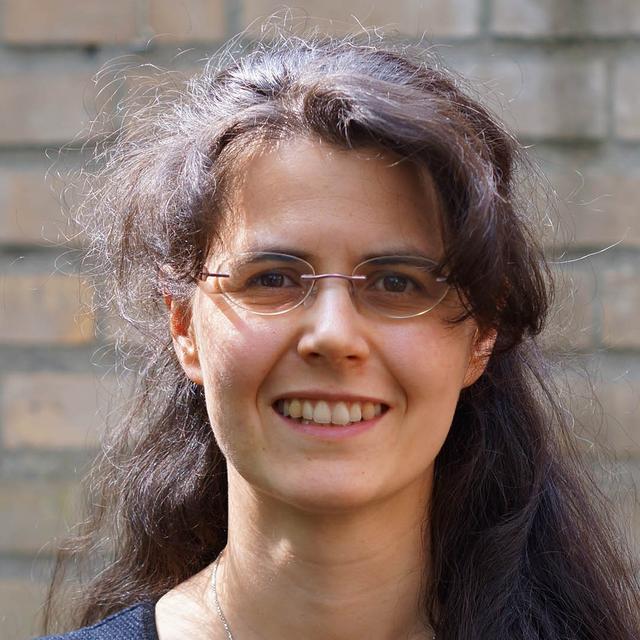 Myrthe PlaisierAssistant professorEindhoven University of Technology
Myrthe Plaisier is an assistant professor in the Human Technology Interaction group at Eindhoven University of Technology. She has been studying touch perception as wel as multisensory perception for many year. Recently she has started to apply her expertise for the development of assistive technology for people with a visual disability or a combined hearing and visual disability.
These technologies include vibrotactile displays as well as displays for relief drawings. She often collaborates with expertise centers and experience experts.
User-validated tactile map design and symbology
Kadaster, Accessibility, Dedicon, and ESRI Nederland are collaborating to create automatically generated tactile maps of Dutch neighbourhoods with ArcGIS software. These maps are meant to help people with a visual impairment (VIP) orientate on their surroundings. To ensure legibility and user-friendliness of the map, human-centred design was employed. Five iterative rounds of user research were performed testing the map symbology, map lay-out, required simplification of geographic data, and design. At the show and tell, you can feel our user-validated tactile map design and tactile symbology set and discuss the research behind it. All map elements and symbology will be made available for public use. Additionally, we can discuss how software helps us to create automatically generated neighbourhood-level.
-
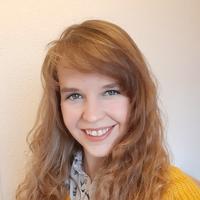 Jolijn JansenAccessibility consultant and user researcher(Stichting Accessibility)
 Jolijn JansenAccessibility consultant and user researcherStichting Accessibility
Jolijn is commited to a society in which everyone can participate independently. Through inclusive design methods, in which a diverse group of end users collaborates in each design stage, she helps organisations to develop accessible and user-friendly products and services. She mainly performs moderated interviews and focus groups with end users. Additionally, she advises on 2.5D tactile design and plain language.
Innovative educational tools for art creation activities for the visually impaired
People with visual impairments perceive the shape of objects primarily through touch. We developed composition units that fit in the palms of both hands. We named the process of assembling the units into different shapes by touching the shape with both hands "Tactile Art". These units are expected to be used in artistic activities and three-dimensional cognition for the visually impaired, as well as in clinical areas such as cognitive improvement for the elderly. Currently, about 10 different tactile units have been developed. Participants are encouraged to compose freely.
-
Toshihiro Kanahori
Toshihiro Kanahori
-
 Hiroshi KatohEmeritus professor(Tsukuba University of Technology, JAPAN)
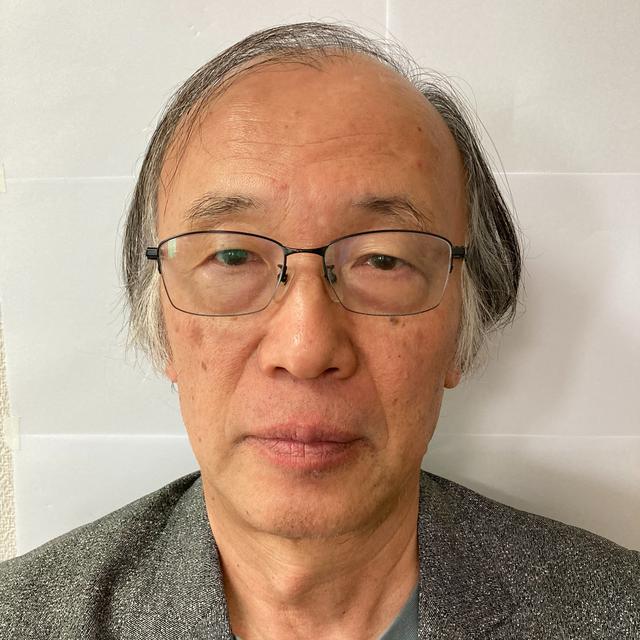 Hiroshi KatohEmeritus professorTsukuba University of Technology, JAPAN
Katoh graduated from the University of Tsukuba in 1979 with a psychology major. His research theme at graduate school was the behavioral genetics of emotional reactivity in rats. From 1990, he taught visually impaired students at Tsukuba University of Technology. He retired in 2021 and is currently participating in the Tactile Art & Therapy Project as a joint researcher.
-
Mitsunobu Matsuo
Mitsunobu Matsuo
-
Haruka Matsuo
Haruka Matsuo
Hymn books of the future
Every week millions of people with print disabilities sit in the church feeling excluded because they cannot participate in the singing. Lyrics and music scores are presented in books or on a screen which are inaccessible to them. Employees and students also struggle to get their work done because they don’t have access to this literature. The Norwegian organization KABB (Christian work among blind andvisually impaired persons) are working to improve the situation. Though hymn books have been produced in braille, this has been a costly and time consuming process, and books in large print have in many cases not been made at all. In Norway there has been no efficient solution for people with print disabilities after the new hymn book of the Norwegian Church was published in 2013. In our project we use the Epub-standard and digital music files as a fundament to present hymns and worship songs in the way the reader needs. By using new technology and innovative solutions for production, we are able to make the songs available for people with different needs in a flexible and cost effectively way. From the same source files, we generate braille, large print and sound to make both digital solutions and printed books.
-
 Solveig-Marie OmaChurch musician and project manager(KABB (Christian work among blind and visually impaired persons))
 Solveig-Marie OmaChurch musician and project managerKABB (Christian work among blind and visually impaired persons)
Solveig-Marie Oma is a church musician and accessibility advocate from Norway, currently based in Leipzig, Germany. She studied church music at the Arctic University of Norway and the Hochschule für Musik und Darstellende Kunst, Stuttgart, graduating in 2021. Solveig works across several projects, including coordinating accessible hymn book production with KABB (Christian work among blind and visually impaired persons), consulting on music braille tools for the DAISY Consortium, and developing online music courses in Germany. She also performs organ concerts and teaches music braille. Her background includes work as an organist, choir conductor, and music teacher.
-
 Øyvind WoieSecretary General(KABB)
 Øyvind WoieSecretary GeneralKABB
Øyvind Woie is the Secretary General of KABB. With a strong background in journalism and leadership, Øyvind has also worked extensively on accessibility issues for the deaf community. He is deeply committed to finding and implementing innovative technical solutions that promote inclusion and improve the quality of life for people with disabilities.
Tactile Graphics for Braille instruction
For its Braille literacy programme directed towards adults, dBSV has created a collection of tactile graphics as pre Braille training: Many adults who are learning Braille face challenges with tactile sensitivity, making it difficult to accurately distinguish the small Braille dots. To address this, the tactile graphics presented here are used as part of a structured Braille teaching program, offering learners the opportunity to improve their tactile skills through simple, engaging exercises. The collection includes a variety of worksheets featuring geometric shapes, line patterns, and tactile mazes. These activities are intended to develop learners' sense of touch in a playful and practical way. By practicing with larger, more accessible tactile forms, learners gradually improve their ability to perceive finer details such as Braille dots. Repeated exposure to these simple tasks not only builds confidence but also strengthens the necessary tactile discrimination skills required for successful Braille reading.
-
Sonja SchmidtTrainer for Braille teachers in the German Federation of the Blind and Partially Sighted(Deutscher Blinden und Sehbehindertenverband (DBSV))
Sonja SchmidtTrainer for Braille teachers in the German Federation of the Blind and Partially SightedDeutscher Blinden und Sehbehindertenverband (DBSV)
Since 2022, I have been working for the German Federation of the Blind and Partially Sighted. We're currently building a nation-wide network of trained Braille teachers for adults.
As I am blind myself, I have been using Braille from a young age, and it's an honour for me to be able to make this important script accessible to more people in my country.
A swimming duck is different from a swimming fish
In 2023 Dedicon had the opportunity to explore a long-desired topic concerning tactile images: the role of ‘conceptual knowledge’ in understanding the world around you and the importance tactile images can play within this topic. With ‘conceptual knowledge’ we refer to potentially missing knowledge caused by the inability to see. This often concerns items that are too far, too large, too small, to explore by touch. It also includes ‘graphic’ items such as logos, numbers and diagrams. A concept is then a mental representation that enables a person to grasp a ‘thing’ and understand the relationship of that ‘thing’ with similar ‘things’. This knowledge helps to quickly place new information (about new ‘things’) or understand what is important or interesting about it. After the first euphoria we realised the challenges concerning this topic. For example: how to investigate the need for something that the user does not always know exists? Also, this research would be small in scale and thus necessarily focus on qualitative results. Note: This table talk is also an invitation in working together with the attendees of the conference; one key to a successful approach of small scale research. The project resulted in several domains of ‘conceptual knowledge’, like how something is put together and its position in space, how something looks and how something ‘works’ (moves, functions, etc). The research project also resulted in a concrete product for the collection of the Dutch Royal Library, available to visually impaired readers in the Netherlands. These so called ‘Begrippenbanden’ (portfolio of concept) exist of tactile images and explanations in text. We will bring examples of these Begrippenbanden to explore with the attendees and hope to gain your view on conceptual knowledge. You are especially invited to share your experiences with investigating elusive needs among blind participants and please react on our list of possible domains and examples within these domains.
-
Anne BottenheftVisual Specialist(Dedicon)
Anne BottenheftVisual SpecialistDedicon
Realtime Collaboration on Graphically Structured Content for Everyone
-
Lukas SchölchResearch Associate(Karlsruhe Institute of Technology (KIT))
Lukas SchölchResearch AssociateKarlsruhe Institute of Technology (KIT)
TMAP: Tactile Maps Automated Production
Tactile map design goes far beyond raising lines and adding braille. We will introduce core principles, relevant terminology, and best practices for tactile map design and production. These include the unique considerations of tactile media and tactile reading, such as distinctions between 2.5D and 3D design, the use of braille beyond labelled callouts, effective methods for simplification, and subjectivity around informational hierarchy. We explore how the content of tactile maps should align with audience needs, preferences, and context, building on users’ own experiences to make tactile maps more intuitive and meaningful.
Through shared examples, we will demonstrate what works well in tactile map design, and what common pitfalls to avoid. Effective tactile maps must simplify complex visuals, focusing on clarity and legibility by using tactually distinguishable lines and textures. Attendees will gain a clearer understanding of tools available for creating tactile maps and graphics, their advantages and limitations, and essential dos and don’ts for creating more accessible and effective tactile maps. By incorporating these approaches, educators, creators, and designers can play a crucial role in fostering inclusion and independence and improving the wayfinding experience for the blind community.
-
 Eleanor MayesDesigner, Media and Accessible Design Lab (MAD Lab)(LightHouse for the Blind and Visually Impaired, San Francisco)
 Eleanor MayesDesigner, Media and Accessible Design Lab (MAD Lab)LightHouse for the Blind and Visually Impaired, San Francisco
With a background in materials engineering and accessible design, Eleanor creates tactile media that furthers accessibility by augmenting the information landscape. She specializes in 2.5D design, transforming visual graphics into tangible formats while working closely with blind individuals to develop bespoke designs that prioritize the broader blind community. Her work supports MAD Lab’s mission to improve access to information for blind and low-vision individuals through tactile graphics, maps, and other resources. Passionate about equity, Eleanor centers her design practice around disabled, BIPOC, and LGBTQ+ communities, advocating for collaborative, inclusive approaches in design and engineering to promote a more just and accessible future.
A tactile approach to an olfactory weekdays system
Individual tactile daily timetables - While tactile timetables are valuable tools, they have a crucial issue: they tend to be individual rather than shared, which can limit opportunities for social understanding of time.
An inclusive weekday system designed with unique multisensory identifiers helps deafblind students build a stronger understanding of weekly time progression, enabling them to independently recognize, anticipate, and structure their daily routines while developing broader temporal awareness.
• Each day has unique multisensory identifiers—incorporating tactile, olfactory, auditory, and visual.
• Multiple sensory inputs reinforce each other, and their consistent use across the whole school fosters inclusion and participation while supporting a shared social temporal understanding of weekdays.
-
 Inez Aschenbrennerteacher for deafblind students(Deutsches Taubblindenwerk Hannover/Bildungszentrum Hören-Sehen-Kommunikation)
 Inez Aschenbrennerteacher for deafblind studentsDeutsches Taubblindenwerk Hannover/Bildungszentrum Hören-Sehen-Kommunikation
I have worked with deafblind / hearing and visually disabled students since 2003.
Since 2003 I have a master in education in speech therapy, education for learning disabilities and since 2007 for educations for the hearing and visually impaired.
At the moment I work to specialize as a teacher for Low Vision in our school for deafblinds in Germany.
Our school ist called educational centre for hearing, vision and communication. Hearing, vision, and communication are the main areas in which people who are deafblind or have dual sensory impairments need support. Orientation is also an essential aspect. That’s why we are proud to present our project on orientation in everyday life here.
-
 Vikram ChoudharySpecial Needs Teacher(Deutsches taubblindenwerk)
 Vikram ChoudharySpecial Needs TeacherDeutsches taubblindenwerk
Vikram Choudhary is a special needs educator at the Deutsches Taubblindenwerk (German
Deafblind Centre), specializing in deafblind education. He holds a Pedagogical Master's degree
in Communication and Deafblindness from the University of Groningen, Netherlands, and is a
certified Supervisor for the Tactile Working Memory Scale (TWMS) through the Nordic Welfare
Centre.
Specializing in congenital deafblindness, Choudhary's expertise focuses on supporting tactile
language acquisition through pre-language development and developing individualized
communication methods for students with congenital deafblindness.
Prior to his current role, Choudhary served as a rehabilitation teacher for adults with acquired
deafblindness, where he specialized in Braille, digital communication, and assistive
technologies.
Possibility and Benefits of 3D CAD Modeling by the Visually impaired
The author, who is himself visually impaired, has been exploring methods for the visually impaired to use 3D CAD modeling. In this presentation, he will explain the 3D CAD method he has developed, with examples of actual products made using it.
There are three main advantages to being able to use 3D CAD by the visually impaired.
1. Firstly, and obviously, they can give shape to their own ideas. When giving instructions to a sighted person to create a shape, it is extremely difficult to create a complex shape exactly as they imagined it. Considering such difficulty, this obvious advantage must be emphasized.
2. Secondly, visually impaired people can make the tools they need themselves.
Since the unique tools that visually impaired people, who are a minority, need (such as white cane holders) are not available on the market, being able to make them yourself is important.
3. Thirdly, it can contribute to improving the quality of tactile teaching materials. If people with visual impairments can make 3D models, they can directly show tactile teaching materials that are easy for them to understand, rather than indirectly explaining them verbally.
The method developed by the author uses programmable CAD software. This method can be implemented using standard computers and assistive devices currently on the market. The author will present examples of the three benefits of 3D CAD modeling by the visually impaired.
In particular, he will introduce models of the Leaning Tower of Pisa and the Taj Mahal to explain the advantage 1: these models4 have also received academic recognition.
-
 Kazunori MinataniProfessor(National Center for University Entrance Examinations)
 Kazunori MinataniProfessorNational Center for University Entrance Examinations
Kazunori Minatani is a Professor at the National Center for University Entrance Examinations in Japan. He specializes in developing accessible testing environment for visually impaired students, including the use of 3D-printed objects and digital tools. Dr. Minatani has contributed significantly to the reform of Japan's university entrance examination system, ensuring inclusivity and equal opportunities for all examinees. His work is recognized internationally, and he actively participates in projects and events related to assistive technology and disability inclusion.
Development and Introduction of the 78 Types Convex-Line Tactile Maze Tasks Consisting Five Instructional Steps
Maze tasks are important for young children from the perspective that they can learn to recognize geometric shapes and form spatial images. In particular, experience playing mazes is important for children with blindness, who have difficulty in spatial recognition, as a basic readiness for reading tactile graphs and diagrams, and for tactile-motor control as a basis for braille reading. However, while visual maze tasks are commercially available, there are no systematized and graded tactile maze tasks. Therefore, we developed the convex-line tactile maze tasks from the following perspectives: (1) presence or absence of dead-end lines, (2) number of corners, (3) number of junctions, (4) location of junctions, (5) distance between junctions, and (6) distance from junctions to dead-ends, and verified the difficulty level of the tasks with four children who are blind. As a result, no reverse movement or stopping of the fingers occurred in the tasks without dead ends, but it’s occurred in the tasks with dead ends. Tasks with more corners and junctions tended to increase reverse movement or stopping of the fingers than those with fewer. There was a tendency for reverse movement or stopping to increase in tasks with a short distance between junctions. In the tasks with a shorter distance between choice points, there was a tendency for more reverse movement or stopping. On the other hand, the position of the junctions and the distance of dead ends did not affect the difficulty of the tasks. Based on these findings, we developed 78 types convex-line tactile maze tasks for children with blindness, consisting of five instructional steps. We will introduce these tasks and the system diagram of the instructional steps.
-
Tsuyoshi SashimaProfessor(University of Tsukuba)
Tsuyoshi SashimaProfessorUniversity of Tsukuba
Tsuyoshi Sashima is a professor at the University of Tsukuba, teaching Psychology/Education of Visual Impairment and Psychology/Education of Multiple Disabilities.
His research focuses on the cognition of children with visual impairment, the expansion of tactile space, and the development of teaching materials that are easy to understand through touch. He has been teaching young children with visual impairment and children with multiple disabilities for over 40 years.
-
Sota SebataGraduate student(Graduate School of Comprehensive Human Sciences, University of Tsukuba)
Sota SebataGraduate studentGraduate School of Comprehensive Human Sciences, University of Tsukuba
Mr. Sota SEBATA is a master's student at Graduate School of Comprehensive Human Sciences, University of Tsukuba, Japan. His major is special needs education and he is researching on tactile symbols for children with multiple disabilities.
-
 Tomoko TateshitaSchoolteacher(Iwate Prefectural School for Ichinoseki-Seimei Special Needs Education)
 Tomoko TateshitaSchoolteacherIwate Prefectural School for Ichinoseki-Seimei Special Needs Education
After receiving my Master's degree, I am currently working as a teacher in a special needs school. In graduate school, I specialized in education of children with visual impairments and researched materials and methods to promote the conceptual development of children with visual impairments.
Inclusive with Emphasis for Visually Impaired Children
Sensory-touch books: the only type of book for all children, regardless of their characteristics. The role of books in the overall development of children is well-established. This role becomes even more important for children with special needs, provided it meets their specific requirement. But do these children have access to the available resources? Why is it that visually impaired children rarely visit libraries? 5 years ago, we established the first sensory-tactile library, the result of over 30 years of diverse efforts. In addition to books, we utilize many other tools and complementary programs. However, only a limited number of our primary audience- children with visual impairments- use the library, and there are many reasons for this. We have planned two approaches to improve access to this library; our first idea is a Mobile Sensory Library. It consists of diverse packages of books on various topics which are taken to centers working with children. These packages are loaned out on a periodic basis, accompanied by storytelling, performances, poetry, and more. The second idea is reading in families and creating groups that align with common needs. Each group consists of 10 families. We provide each family with a lending package of books. In subsequent meetings, they discuss their experiences and exchange their packages. This plan helps foster connections between children and their families. Each package includes sensory and tactile books, fiction and nonfiction, poetry, Braille with color-printed text and images, books suitable for other family members, general parenting books, and books addressing the special needs of their child. Additionally, there is a guide and a notebook for their thoughts and experiences, along with various tools to aid in a better understanding of the books.
The Project showcased in this Seminar:
”A Backpack Full of Books" (Kooleh Poshti-ye Ketab)
This is a family reading initiative, aiming to:
- Spread the joy of tactile and Braille book experiences among family members.
- Strengthen bonds, communication, and mutual understanding within families.
- Showcase diverse tactile-sensory books and highlight literature’s transformative role in children’s and families’ lives.
-
 Zahra FarmaniAuthor, researcher, Art institute teacher(Badbadak art school, division of tactile books)
 Zahra FarmaniAuthor, researcher, Art institute teacherBadbadak art school, division of tactile books
Zahra Farmani (I go by Zohre)
*Born:* 1955
*From:* Tehran, Iran
✅ Active in the field of tactile-sensory books and education for visually impaired children, including:
- Author, designer, and creator of tactile-sensory books for visually impaired children.
- Four-time award-winning tactile-sensory book author at *IBBY* (since 1999).
- Jury member for tactile-sensory book selection at the Children’s Book Council of Iran
- Founder of volunteer groups for prototyping tactile-sensory books.
- Collaborator on student research projects.
- Organizer of exhibitions and workshops on tactile-sensory books at universities and blind centers across Tehran and other cities.
- Founder of Iran’s first tactile-sensory library for visually, impaired and blindchildren.
✅ General activism in children’s advocacy:
- Director of four cultural-educational centers for children.
- Board member of the *Research Institute for Children of the World* .
- Managing Dirctor of the *International virtual Museum of Children’s Art*.
Living braille
In 2022, the Braille working group of European Blind Union established European digital resource for braille. livingbraille collects the data from all over Europe and world, bringing the European braillists unique opportunity to get a rich braille experience and knowledge at one place. Everyone can become a part of livingbraille easily and contribute to this initiative with braille experience in their country. We collect information about braille learning methods, techniques, about digital braille resources, braille displays and practically everything related to braille. This website is going to be a landing page for 2025 EBu Braille 200 initiative. We would like to present this as a poster presentation, explaining the necessity to contribute to our collective European braille website. We also want to inform our colleagues about this website, which can become their inspiration and knowledge database, as more and more people come to add their braille knowledge and experience. We would like to have a possibility to install a poster of livingbraille and a stand-post for a person delegated by our group to share information about this braille resource with the participants.
-
 Michal TkacikLead coordinator of the Braille Authority of Slovakia(the Braille Working Group of European Blind Union)
 Michal TkacikLead coordinator of the Braille Authority of Slovakiathe Braille Working Group of European Blind Union
Working in the Matej Hrebenda Slovak Library for the Blind as a lead coordinator of the Braille Authority of Slovakia and is currently elected as the Vice-President of the Slovak Blind and Partially Sighted Union. Studied the social and work psychologi and Comenius University. After studium worked as a CRM specialist in the insurance company. From 2021 continually working in area od braille advocacy, promotion and code rules development in Slovakia.
Closing
16:30 - 17:00h
Eva Slootweg is a teacher and student coach at Visio Rotterdam and actively works on inclusion projects with Royal Visio. In 2023, she was a finalist for Teacher of the Year in Special Education.
Eva Slootweg: “Social contacts and awareness of yourself and the environment you are in. That is my beautiful profession as a teacher of social skills! My closing of the day will be about Empowerment. How can you Empower yourself and how can you help someone else to Empower. With some input from students and from you, I hope you will end the day inspired and empowered.”
17:00 - 17:15h
EBU (European Blind Union)
This year we celebrate the 200th anniversary of Braille. EBU promotes braille and braille literacy as essential tools for the autonomy of blind and partially sighted individuals. What is the value of braille in peoples lives? A session speaking about the contributions and braille 200 bicentenary within EBU.
-
 Eva SlootwegTeacher(Royal Dutch Visio)
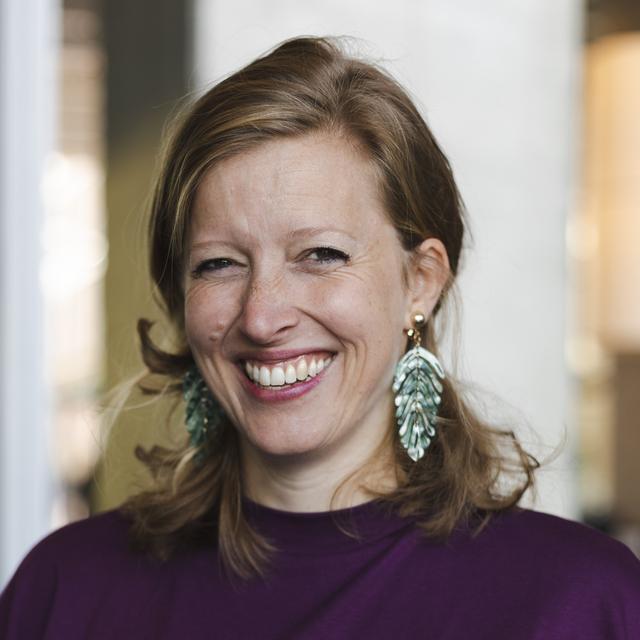 Eva SlootwegTeacherRoyal Dutch Visio
Social contacts and awareness of yourself and the environment you are in. That is my beautiful profession as a teacher of social skills!
My closing of the day will be about Empowerment. How can you Empower yourself and how can you help someone else to Empower.
With some input from students and from you, I hope you will end the day inspired and empowered.
Opening: Braille: celebrating the legacy, and looking to the future
During the Tactile Reading Conference, Jonathan Mosen and Prof. Dr. Markus Lang will do a keynote together.
Where the keynote of Jonathan Mosen will focus on What are the lessons of the invention of Braille and what can it teach us about the self-determination of blind people. Jonathan will demonstrate that Braille was developed often while encountering fierce resistance from sighted people who thought hey new better about how blind people should read than blind people themselves.
Prof. Dr Markus Lang will share the main findings of this research project, including the meaning and relevance of Braille, usage patterns and reading skills. Together, we will focus on the challenges for practice:
- What role do assistive technologies play?
- What are the needs of dual media users?
- What are the essential requirements for learning to read and write Braille?
- And how can we implement them effectively?
We invite you to think about these questions and discover together how we can bring braille education and usage to the next level.
-
 Markus LangProfessor of Special Needs Education in the context of Blindness and Visual Impairment(Heidelberg University of Education)
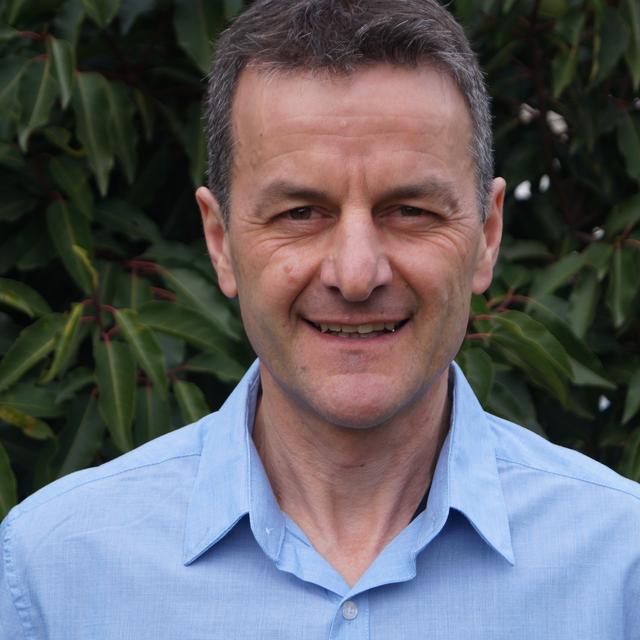 Markus LangProfessor of Special Needs Education in the context of Blindness and Visual ImpairmentHeidelberg University of Education
Markus Lang is Professor of Special Needs Education in the context of Blindness and Visual Impairment (Heidelberg University of Education).
Studies
- University of Education Schwäbisch Gmünd (1989-1992): Teaching degree for primary and lower secondary schools (specialising in history, German, music)
- Heidelberg University of Education (1992-1994): Teaching degree in special needs education (specialism: Education in the context of Blindness and Visual Impairment)
Doctorate (1999-2002)
- Dissertation on “The promotion of haptic perception to prepare blind children for the acquisition of Braille”
Employment
- Teacher in Special Needs Education at the Schloss-Schule Ilvesheim (School for the Blind and Visually Impaired) (1996-1999 and 2002-2005)
- Substitute Professor of Special Needs Education in the context of Blindness and Visual Impairment at the Heidelberg University of Education (2005-2012)
- Professor of Special Needs Education in the context of Blindness and Visual Impairment at the Heidelberg University of Education (since 2013)
-
 Jonathan MosenExecutive Director, Accessibility Excellence(National Federation of the Blind)
 Jonathan MosenExecutive Director, Accessibility ExcellenceNational Federation of the Blind
Jonathan Mosen MNZM directs accessibility excellence initiatives at the US-based National Federation of the Blind. He relocated to the United States from New Zealand in 2024 to take up this role.
At the NFB, Jonathan manages relationships with the world's largest technology companies, as well as start-ups who may have the next big idea for access technology as it affects blind people.
He has been a thought leader, broadcaster, podcaster, advocate, change agent, government relations professional, author, CEO, DPO leader, information technology consultant, Internet start-up founder, candidate for Parliament, IT product designer, and non-profit Chair. He is a passionate champion of Braille.
Inclusive Toys and Games for Individuals with Visual Impairments: from Japan, India, U.S., Germany
Toys and games are powerful tools for facilitating the development of various skills, including fine and gross motor skills, as well as cognitive, tactile, and spatial skills, from a very young age in children who are blind. Furthermore, toys and games that promote not only solitary play but also parallel or cooperative play can foster speech, language, social, and emotional development. However, not all toys are accessible to children with blindness, and accessible toys made specifically for them can be costly. This interactive workshop will showcase eight different popular toys and games that are accessible and low-cost for individuals with blindness in Japan, India, the United States, and Germany. Examples include origami from Japan, Pallankuzhi and Snakes and Ladders from India, Legos, toy cars, and Slinkys from the U.S., and Hubelino and Schleich figures from Germany. These widely used toys are also enjoyed by sighted individuals, yet they incorporate specific textures, tactile cues, or emit sounds that provide haptic and/or auditory feedback, making them accessible to those with blindness. The eight toys and games were selected based on a study involving interviews with 25 adults with blindness; 6 from Japan, 10 from India, 4 from the U.S., and 5 from Germany, all of whom had graduated from college or university (with an associate's degree or higher) and were employed or had previously worked in various professions. The study utilized 30 to 40 minute semi-structured interviews, during which participants were asked questions such as, "What was your favorite childhood toy or game, and why?". The specific results will be discussed in the workshop. Attendees will have the opportunity to interact with the toys and leave with ideas that can be easily incorporated into their daily practices in their home countries.
-
 Tina HerzbergProfessor and Coordinator of the Visual Impairment Education Program(University of South Carolina Upstate)
 Tina HerzbergProfessor and Coordinator of the Visual Impairment Education ProgramUniversity of South Carolina Upstate
Dr. Tina S. Herzberg is a Professor at University of South Carolina Upstate where she has coordinated the Visual Impairment Education Program since 2007. She is also the co-author of the Pearson Nemeth Curriculum, and the principal investigator of Project INSPIRE 2: Access and Equity in STEM Learning for Individuals Who Read Braille. Tina is a certified teacher of students with visual impairments and a certified orientation and mobility specialist as well as a former middle school mathematics and English teacher.
-
 Hisae MiyauchiResearcher(University of Tsukuba, Japan)
 Hisae MiyauchiResearcherUniversity of Tsukuba, Japan
Dr. Hisae Miyauchi is an Associate Professor at the University of Tsukuba, Division of Disability Sciences, Japan. She serves as the Principal Investigator for the four-year, Japanese Ministry of Education-funded project, "Inclusive Graphicacy Tools and Techniques for Promoting Access to STEM Education”. The project addresses the global challenge of exclusion of students with blindness from the STEM field, involving researchers with expertise in mathematics and visual impairment from the US, Europe, and Asia.
-
 Marie-Luise SchüttCoordinator for accessible educational processes in schools and universities(Universität Hamburg)
 Marie-Luise SchüttCoordinator for accessible educational processes in schools and universitiesUniversität Hamburg
Marie-Luise Schütt has a doctorate in education for the blind and visually impaired and has already been involved in various international and national projects in this field of work. She has been working as a coordinator for accessible educational processes in schools and universities at the University of Hamburg since 2024.
-
Robinson ThamburajAssociate Professor(Madras Christian College, India)
Robinson ThamburajAssociate ProfessorMadras Christian College, India
Dr. Robinson Thamburaj is an Associate Professor and Head of the Department of Mathematics at Madras Christian College, India. He obtained PhD in Computer Mathematics from the University of Madras in 2001 and second PhD in Disability Sciences from the University of Tsukuba, Japan in 2006. His research interest includes Automata Theory, Image Analysis, Nature-inspired Computing, Tactile Geometry, and Inclusive Education. He has published about 80 research articles in reputed journals. Under his supervision 5 scholars completed their PhDs and 6 more are currently pursuing.
Ministry of Social Justice and Empowerment, Government of India conferred him with a National Award in 2005 for his contribution in the field of welfare of persons with disabilities.He availed patent on his assistive device Tactile Graphic Drawing Kit in 2023.
Certified and trained by Centre of Excellence in Science and Mathematics Education (CoSME), Indian Institute of Science Education and Research (IISER), Pune he is a workshop trainer for college teachers
on Research Based Pedagogical Tools.